


-

Rewild School: A Pedagogy of Possibility
Shawn Humphrey
Our education system is dangerously outdated.
While the times are placing more and more emphasis on creativity, adaptability, and global consciousness, our education system continues to transform too many of our audacious and curious young people into 20th century cogs for yesterday’s machinery. Knowing this, how do we get our students to shed their submissiveness, rediscover their uniqueness and share their vision of the world with the rest of us?
Rewild School puts forward a daring answer.
Part memoir and manual, award winning educator Shawn Humphrey shares his decade-long quest to reimagine education. Weaving insights from pedagogy, mythology, and the field of social innovation, this paradigm-shifting manifesto gives educators a 10-step process for guiding students and teacher alike on a journey of self-discovery – a journey to meet their inner genius.
-
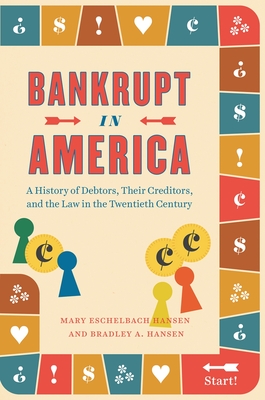
Bankrupt in America: A History of Debtors, Their Creditors, and the Law in the Twentieth Century
Mary Eschelbach Hansen and Bradley A. Hansen
In 2005, more than two million Americans—six out of every 1,000 people—filed for bankruptcy. Though personal bankruptcy rates have since stabilized, bankruptcy remains an important tool for the relief of financially distressed households. In Bankrupt in America, Mary and Brad Hansen offer a vital perspective on the history of bankruptcy in America, beginning with the first lasting federal bankruptcy law enacted in 1898. Interweaving careful legal history and rigorous economic analysis, Bankrupt in America is the first work to trace how bankruptcy was transformed from an intermittently used constitutional provision, to an indispensable tool for business, to a central element of the social safety net for ordinary Americans. To do this, the authors track federal bankruptcy law, as well as related state and federal laws, examining the interaction between changes in the laws and changes in how people in each state used the bankruptcy law. In this thorough investigation, Hansen and Hansen reach novel conclusions about the causes and consequences of bankruptcy, adding nuance to the discussion of the relationship between bankruptcy rates and economic performance.
-
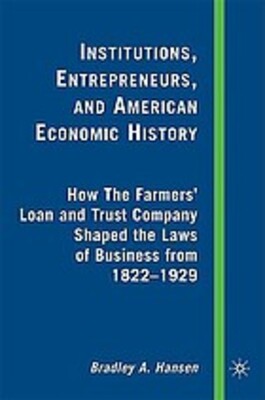
Institutions, Entrepreneurs, and American Economic History: How the Farmers’ Loan and Trust Company Shaped the Laws of Business from 1822 to 1929
Bradley A. Hansen
Institutions, Entrepreneurs, and American Economic History: How the Farmers’ Loan and Trust Company Shaped the Laws of Business from 1822 to 1929 examines how a single, influential financial institution helped transform American business law during the nineteenth and early twentieth centuries. Using the Farmers’ Loan and Trust Company of New York as a case study, the book shows how trust companies and their leaders acted as legal and institutional innovators—crafting new financial instruments, corporate structures, and governance practices to meet the needs of industrializing markets. It argues that changes in U.S. business law did not arise solely from legislatures or courts acting in the abstract, but were actively shaped by entrepreneurs and financial intermediaries who pushed legal boundaries and then worked to legitimize those innovations. In doing so, the book links firm-level strategy to broader developments in corporate law, finance, and American economic growth from the early republic through the eve of the Great Depression.
Printing is not supported at the primary Gallery Thumbnail page. Please first navigate to a specific Image before printing.