

-
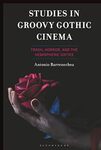
Studies in Groovy Gothic Cinema: Trash, Horror, and the Hemispheric Sixties
Antonio Barrenechea
In Studies in Groovy Gothic Cinema, Antonio Barrenechea launches an inquiry into inter-American exploitation cinema-a horror cinema which captured the rise of '60s counterculture and youth-oriented lifestyles-as it harnessed the cultural zeitgeist through gratuitous depictions of sex, blood, and music.
Despite the genre's cultural impact, Barrenechea argues, its association with vulgar taste, shoestring budgets, and cheap thrills makes it often overlooked in existing cinema history and scholarship. This book places film studies and comparative American studies into a new conversation involving exploitation cinema, targeting an American hemispheric tradition and considering how art and trash intersect in undisciplined ways. -
Ch. 3: A Generative AI (GAI) Writing Pedagogy: How Composition Pedagogy Can Inform the GAI Turn
Brenta Blevins
This chapter appears in the book, Rethinking Writing Education in the Age of Generative AI. Edited by Chaoran Wang and Zhongfeng Tian.
Chapter abstract: In response to some educators’ concerns that Generative Artificial Intelligence (GAI) means the end of writing assignments and classes, this chapter contends that GAI represents the latest development in a long history of literacy technologies that begins with writing itself as a technology. After first presenting broad overviews of GAI tools and composition pedagogy, this chapter next reviews specific composition pedagogies and describes how each can inform course designs, writing instruction, and assignments addressing students’ increased access to GAI. These—and other—composition pedagogies offer distinctive emphases and perspectives that can prepare writers for present and future occasions in which they may write and be expected to compose alongside GAI.
This chapter’s overview of multiple composition pedagogies highlights how each approach can inform course development and GAI integration to support essential writing instruction and AI literacy. This discussion underscores the adaptability of various pedagogies to different instructional contexts and individual instructor values and goals. However, while this chapter asserts that existing composition pedagogies continue to offer guidance in teaching writing in the GAI era, this chapter does not argue for incorporating GAI into every writing occasion or to mandate its use. The chapter concludes by considering how some composition pedagogies may be less compatible with GAI and emphasizes the need for continued research.
-
Ch. 3: Impact of Emergent Technologies on Writing Centers and Pedagogy
Brenta Blevins and Lindsay A. Sabatino
This chapter appears in the book, Impact of Emergent Technologies on Writing Centers and Pedagogy. Edited by Tingjia Wang.
Chapter abstract: Writing centers are adapting to support multimodal and digital literacy projects, addressing challenges from emerging technologies. This chapter argues that writing centers can lead digital literacy initiatives by offering pedagogy of play-informed faculty development workshops. The workshops aim to enhance instructors' digital design skills and pedagogical approaches, contributing to student success and offering professional development for tutors. The chapter begins by outlining the theoretical foundations of pedagogy of play, digital literacy, and faculty development. It then provides a detailed description of a digital photography workshop, emphasizing play in active learning to illustrate this professionalization approach. The chapter concludes by evaluating the workshops' impact and discussing potential adaptations, challenges, and solutions. The adaptability of these workshops demonstrates the benefits of play-based learning for digital literacy.
-
The Importance of Being Different: Disability in Oscar Wilde's Fairy Tales
Chris Foss
Over the course of his remarkable career, Oscar Wilde published two volumes of fairy tales: The Happy Prince and Other Tales and A House of Pomegranates. Both collections feature numerous stories with protagonists who may be said to be disability-aligned, owing to their pronounced physical differences. In The Importance of Being Different, Chris Foss explores the way that Wilde’s stories problematically replicate many of the Victorian era’s typical responses to disability but also the ways they diverge, offering a more progressive orientation—both through more sympathetic identifications with disability-aligned characters and through a self-conscious foregrounding of the mechanisms of pity and the consumption of pain. The first ever monograph to examine Wilde’s work through a disability studies lens, this groundbreaking book encompasses all of his fairy tales as well as his writings during and after imprisonment. Even though Wilde unflinchingly represented the extent to which these peculiar bodies suffered rejection by society, he encouraged his readers to embrace them and to advocate for emotional responses that engage love and kindness toward both individual transformation and social change.
-
Ch. 9: Intersectionality, Inclusion, and the Shakespeare Survey Course
Maya Mathur
This chapter appears in the book, Inclusive Shakespeares: Identity, Pedagogy, Performance. Edited by Sonya Freeman Loftis, Mardy Philippian, and Justin P. Shaw.
Chapter abstract: This essay answers calls to diversify the Shakespeare curriculum by examining the impact of an intersectional approach on student engagement with Shakespeare. Drawing on Kimberle Crenshaw’s description of intersectionality, I consider the benefits of using multiple approaches, including those centered on gender, sexuality, race, and disability, to teach a selection of Shakespeare’s plays. I offer guidelines on how I introduce these perspectives and use them as frames of analysis for class discussion and written assignments. I also draw on the methodologies associated with the Scholarship of Teaching and Learning (SoTL) to demonstrate the advantages of this approach. More popular in the social sciences than the humanities, SoTL encourages instructors to use qualitative and quantitative methods to assess the effectiveness of their teaching. Keeping these principles in mind, I examine students’ written responses on discussion boards and surveys to gauge their interest in different approaches to reading Shakespeare and analyze possible reasons for their preferences. I use evidence of student investment in intersectional reading practices to suggest that small changes to curriculum design and assessment can produce a more inclusive environment for teaching and learning.
-
Living Room
Laura Bylenok
Deeply phenomenological and ecological, Laura Bylenok’s poems in Living Room imagine the lived reality of other organisms and kinds of life, including animals, plants, bacteria, buildings, and rocks. They explore the permeability of human and nonhuman experience, intelligence, language, and subjectivity. In particular, the poems consider so-called model organisms—nonhuman species studied to understand specific and often human biological processes, diseases, and phenomena—as well as an experience of self and world that cannot be objectively quantified. The impulse of these poems is to slow down, to see and feel, and to listen closely. Language becomes solid, palpable as fruit. Long lines propel breath and push past the lung’s capacity.
Life at a cellular level, synthesis and symbiosis, is revealed through forests, fairy tales, and vines that grow over abandoned houses and hospital rooms. A living room is considered as a room that is lived in and also a room that is alive. Cells are living rooms. A self is a room that shares walls with others. Interconnection and interplay are thematic, and the network of poems becomes a linguistic rendering of a heterogeneous and nonhierarchical ecosystem, using the language of biology, genetics, and neurochemistry alongside fairy tale and dream to explore the interior spaces of grief, motherhood, mortality, and self. -
Execute the Office: Essays with Presidents
Colin Rafferty
Colin Rafferty’s Execute the Office uses lyric prose and formal invention to explore the humanity, or lack thereof, that thrived in each of the forty-five American presidents. Whether these powerful individuals were celebrated for infamous deeds and heroism, or forgotten as placeholders in the annals of American history, too often presidents are commemorated by the sterility of simple fact. Execute the Office builds upon factual accuracy with essays that are equally invested in lyrical writing and experimental forms. To balance these factions, Execute the Office uses constraint, metaphor, allusion, and epiphany to explore not just the facts and artifacts of history, but describe the connections between those facts and human nature in thought-provoking and inventive ways. These essays discuss the modes in which we remember. Through death songs, footnotes, infinite rooms, evacuation routes, and nomenclatures, to name a few examples, these diverse essays engage with history from fresh perspectives. Execute the Office contains histories in and of unusual objects. While unfamiliar at first, they soon become distinct, unforgettable, profound, human.
-
Ch. 7: Peace, Friendship, and “The Educated Man’s Sister” in Woolf’s Pacifist Writing
Kate Haffey
This chapter appears in the book, Virginia Woolf, Europe, and Peace: Vol. 1 Transnational Circulations. Edited by Ariane Mildenberg and Patricia Novillo-Corvalan.
Chapter abstract: This chapter explores the connection between Woolf’s notions of friendship and her critical writings about peace and pacifism. For Woolf, friendship not only constitutes a personal intimate relationship with another person, but it also represents a force that stands in opposition to oppressive impersonal concepts like nationalism, imperialism, and militarism—and is thus deeply intertwined with her particular brand of pacifism. In order to make this argument, the chapter employs Derrida’s The Politics of Friendship and explores the place of the sister in his text. Though Derrida traces the relationship between the friend and the brother throughout the history of western thought concerning friendship, he often stops to ask about the absence of the sister. His book ultimately shows that this figure of the “friend in the feminine” could be the key to thinking politics “beyond the principle of fraternity.”
-
Literary Modernism, Queer Temporality: Eddies in Time
Kate Haffey
This book explores the intersection between the recent work on queer temporality and the experiments of literary modernism. Kate Haffey argues that queer theory’s recent work on time owes a debt to modernist authors who developed new ways of representing temporality in their texts. By reading a series of early twentieth-century literary texts from modernists like Woolf, Eliot, Faulkner, and Stein alongside contemporary authors, this book examines the way in which modernist writers challenged narrative conventions of time in ways that both illuminate and foreshadow current scholarship on queer temporality. In her analyses of contemporary novelists and critics Michael Cunningham, Jeanette Winterson, Angela Carter, and Eve Sedgwick, Haffey also shows that these modernist temporalities have been reconfigured by contemporary authors to develop new approaches to futurity.
-
Ch. 5: "Afoot with my vision": Whitmania and Tourism in the Digital Age
Mara Scanlon
This chapter appears in the book, From Page to Place: American Literary Tourism and the Afterlives of Authors. Edited by Jennifer Harris and Hilary Iris Lowe.
Chapter abstract: This essay draws upon my experience as a teacher of a digitally-inflected seminar on the American poet Walt Whitman in examining how our practices and experiences as literary tourists are affected by the promises of accessibility and immediacy on the internet. The essay raises questions about what “seeing things” really means, questions that are entwined for me with Whitman’s own exhortations: “You shall no longer take things at second or third hand, [. . .] nor feed on the spectres of books,” he tells us, “You shall not look through my eyes either.” What is the difference between our eyes and the lens of the digitizing scanner or photographer? How do we “remember” something we see in person when the digital images of it that are available are all of higher quality but framed by someone else? When we tour online, are we taking things at second or third-hand? Or, instead, are we fooling ourselves that we are really, truly seeing through an author’s eyes and not just our own when we stand in the author’s prior physical spaces?
-
Disability in Comic Books and Graphic Narratives
Chris Foss, Jonathan W. Gray, and Zach Whalen
Disability in Comic Books and Graphic Narratives invites readers to consider both canonical and alternative graphic representations of disability. Some chapters focus on comic superheroes, from lesser-known protagonists like Cyborg and Helen Killer to classics such as Batgirl and Batman; many more explore the amazing range of graphic narratives revolving around disability, covering famous names such as Alison Bechdel and Chris Ware, as well as less familiar artists like Keiko Tobe and Georgia Webber. The volume also offers a broad spectrum of represented disabilities: amputation, autism, blindness, deafness, depression, Huntington's, multiple sclerosis, obsessive-compulsive disorder, speech impairment, and spinal injury. A number of the essays collected here show how comics continue to implicate themselves in the objectification and marginalization of persons with disabilities, perpetuating stale stereotypes and stigmas. At the same time, others stress how this medium simultaneously offers unique potential for transforming our understanding of disability in truly profound ways.
-
Hallow This Ground
Colin Rafferty
Beginning outside the boarded-up windows of Columbine High School and ending almost twelve years later on the fields of Shiloh National Military Park, Hallow This Ground revolves around monuments and memorials—physical structures that mark the intersection of time and place. In the ways they invite us to interact with them, these sites teach us to recognize our ties to the past. Colin Rafferty explores places as familiar as his hometown of Kansas City and as alien as the concentration camps of Poland in an attempt to understand not only our common histories, but also his own past, present, and future. Rafferty blends the travel essay with the lyric, the memoir with the analytic, in this meditation on the ways personal histories intersect with History, and how those intersections affect the way we understand and interact with Place.
-
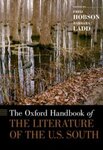
Ch. 16: Tennessee Williams and the Burden of Southern Sexuality Studies
Gary Richards
This chapter appears in the book, The Oxford Handbook of the Literature of the U.S. South. Edited by Fred Hobson and Barbara Ladd.
Chapter abstract: Although contemporary southern sexuality studies, especially as impacted by literary scholars and historians, continue to grow in nuance and complexity, the field often positions Tennessee Williams as a lynchpin figure. On the one hand, he enriches this field in multiple ways, including through his accessible sexuality, his astonishingly diverse set of writings in multiple genres, and his wide-ranging, provocative representations of sexuality. On the other hand, it stands to imperil southern studies, southern drama studies, and southern sexuality studies when interrogations of his work, taken to be the sum of southern drama, are limited to The Glass Menagerie, A Streetcar named Desire, and Cat on a Hot Tim Roof. In contrast to this valorized trinity, his other plays from throughout his long career and especially his unexplored fiction offer a radically different imagining of gayness, one marked by mentorship and camaraderie.
-
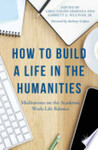
Ch. 15: Aging: “Why Should Not Old Men Be Mad?”
Eric G. Lorentzen
This chapter appears in the book, How to Build a Life in the Humanities: Meditations on the Academic Work-Life Balance. Edited by Greg Colon Semenza and Garrett A. Sullivan.
Chapter abstract: The two epigraphs above represent significantly disparate musings on the benefits or pitfalls of the experience of aging. From as early in my post-secondary education as I can remember, I have tended to gravitate toward the former, less sympathetic mindset about getting old. While I was still a teenaged undergraduate, I was keenly aware that I would invariably feel the effects of time in a painful way, and I routinely entertained fears that I would, someday, cease to be. I wasn’t sure about why I had these anxieties, or whether others shared similar fears, but I was aware of the shaping influence they had on my life. I suffered my first full-blown “midlife” crisis at 25, and spent a considerable amount of time negotiating the ways in which art, literature, music, film, and other humanistic endeavors engaged ideas of both growing up and growing old.
-
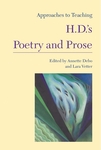
Chapter: Companions of the Flame: Teaching H.D. with Other Modern Poets
Mara Scanlon
This chapter appears in the book, Approaches to Teaching H.D.’s Poetry and Prose. Edited by Annette Debo and Lara Vetter.
Chapter abstract: Here I posit that H.D., now recognized as a significant and innovative poet, might be placed right in the conceptual center of a course on modern poetry, enmeshed in a web of modernist practice and concerns that includes the foundational revisions of imagism; vision, prophecy, and the occult; the shift from lyric to epic form; engagement with old and new mythologies; linguistic and formal experimentation; a rejection of the hegemonic; interrogation of gender and sexuality; and the trauma of war. This chapter examines H.D. in relation to a variety of other poets, including Pound, Williams, Stein, Moore, Owen, and Hughes.
-
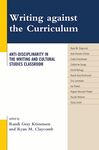
Ch. 9: "Only Connect": Doing Dickens, Cultural Studies, and Anti-Disciplinarity in the University Literature Classroom
Eric G. Lorentzen
This chapter appears in the book, Writing against the Curriculum: Anti-Disciplinarity in the Writing and Cultural Studies Classroom. Edited by Randi Gray Kristensen and Ryan M. Claycomb.
Chapter abstract: Any professor or instructor committed to a student-centered critical pedagogy in the university literature classroom practices a kind of connection between the subjects they teach and their students' actual lives that Forester's quote above embodies. One of the prominent strategies of progressive critical educators relies on the premise that "one secret to good teaching is the ability to discover fresh dimensions in celebrated material," and thus make schooling relevant to students as a vital force in their own contemporary worlds.
Printing is not supported at the primary Gallery Thumbnail page. Please first navigate to a specific Image before printing.