

-
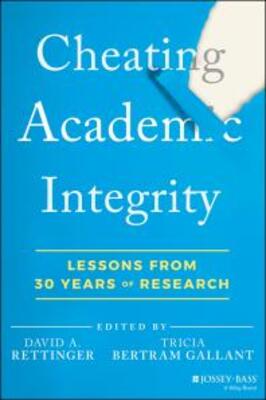
Cheating Academic Integrity: Lessons from 30 Years of Research
David A. Rettinger and Tricia Bertram Gallant
Practical and insightful solutions to the growing problem of academic dishonesty In Cheating Academic Integrity: Lessons from 30 Years of Research, a team of renowned academic integrity experts delivers revealing and practicing insights into the causes of--and solutions to--academic cheating by students. This edited volume combines leading research from an interdisciplinary group of scholars, offering readers an overview of the most important topics and trends in academic integrity research. The book focuses on teaching, classrooms, and faculty behavior and offers a glimpse into the future of this rapidly developing field. Readers will also find: Discussions of the newest forms of cheating, including online "contract cheating" and "paper mills" and the methods used to combat them Explorations of the prevalence of cheating and plagiarism between 1990 and 2020 Psychological perspectives on the student motivations underlying academic integrity violations Teaching and learning approaches to reduce academic misconduct in both online and in-person courses A must-read resource for administrators, leaders, and policymakers involved with higher education, Cheating Academic Integrity also belongs on the bookshelves of school administrators-in-training and others preparing for a career in education.
-
Ch. 31: “You Will Find Out When the Time Is Right”: Boys, Men, and Menstruation
Mindy J. Erchull
This chapter appears in the book, The Palgrave Handbook of Critical Menstruation Studies. Edited by Chris Bobel, Inga T. Winkler, Breanne Fahs, Katie Ann Hasson, Elizabeth Arveda Kissling, and Yomi-Ann Roberts.
Chapter abstract: The majority of menstruators are women—although not all women menstruate and not all menstruators are women. Given this, it is not surprising that there has been little focus on the attitudes about and experiences with menstruation among men. This chapter reviews the research about menstruation and boys and men who are not themselves menstruators in order to shed light on how they learn about menstruation, what they actually know about menstruation, and what beliefs and attitudes boys and men hold about both menstruation and menstruators. It is important to note that nearly all of the research in this area reflects an underlying assumption of a gender binary. Because of this, binary gendered language is often used in this chapter to reflect the nature of the research that has been done. Moreover, this chapter focuses cisgender boys and men. While a critically important topic to study, the experiences of men and non-binary people who menstruate is not covered in this chapter—largely because, to date, there is little academic work on this topic.
-
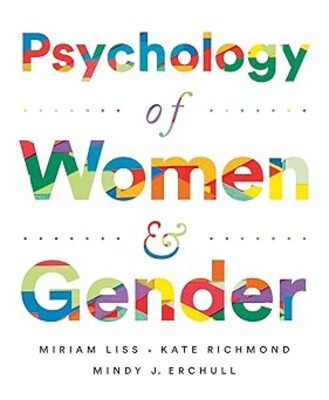
Psychology of Women and Gender
Miriam Liss, Kate Richmond, and Mindy J. Erchull
Providing a lens for interpreting the ever-changing issues that influence girls, women, and trans and/or gender nonbinary individuals today, Psychology of Women and Gender 2e incorporates an intersectional lens throughout the text. It expands the idea of gender by challenging assumptions of a gender binary and includes additional focus on the experiences of men. The new edition is grounded in both feminist theory and psychological research. A new research methods chapter teaches students to use research and critical thinking to strengthen their own voices. Student learning becomes active with a new and engaging Norton Illumine Ebook that engages students with active learning opportunities, including embedded videos that make the content come alive through the voices of diverse individuals, and Check Your Understanding questions that provide retrieval practice so students “lock in” what they learn in every section.
-
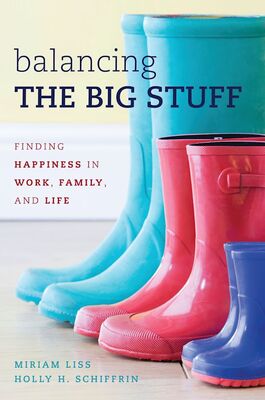
Balancing the Big Stuff: Finding Happiness in Work, Family, and Life
Miriam Liss and Holly H. Schiffrin
While the current conversation about work-family balance and “having it all” tends to focus on women, both men and women are harmed when conditions make it impossible to balance meaningful work with family life. Yet, both will benefit from re-evaluating what it means to have it all and fighting for changes in their relationships and society to make greater equality possible. Here, Miriam Liss and Holly Hollomon Schiffrin discuss the ways in which we all define “having it all” and how we can obtain it for ourselves through a better evaluation of what we want from ourselves, our families, our jobs, and each other. Determining a 50/50 division of labor around the house may not be the thing that works for everyone. Working from home or not at all may not be the thing to bring us satisfaction, but learning what studies show and how to feel balanced and make those decisions to bring balance is crucial. The authors argue that people can find balance in their roles by doing things in moderation. Although being engaged in both parenting and work is good for well-being, people can avoid the pitfalls of over-parenting and over-working. They show that balance can come from a meaningful consideration of what happiness and contentedness mean to us as individuals, and how best to achieve our goals within the limitations of our current circumstances. They illustrate that balance is not simply an individual problem. Social issues such as the lack of parental leave, flexible work schedules, and affordable, high quality child care make balance difficult.
-
Ch. III: Teasing, Bullying, and Emotion Regulation in Children of Incarcerated Mothers
Barbara J. Myers, Virginia H. Mackintosh, Maria I. Kuznetsova, Geri M. Lotze, Al M. Best, and Neeraja Ravindran
This chapter appears in the book, Relationship Processes and Resilience in Children with Incarcerated Parents. Edited by Julie Poehlmann, J.M. Eddy, and Patricia J. Bauer.
Chapter abstract: For better or for worse, every child, adolescent, and adult is teased; it is a normative part of living (Warm, 1997). Teasing can be playful or hurtful, but the line between the two is not always clear (Keltner, Capps, Kring, Young, & Heerey, 2001). The ambiguity between hostile and friendly teasing is part of the very nature of teasing, and teasing can cross into bullying (Mills & Carwile, 2009). Whereas teasing may be positive, bullying is always negative, as it intentionally inflicts injury or discomfort upon another (Olweus, 2006). Teasing is universal, but there is tremendous variability in how well children cope with teasing and the extent to which their own gibes are designed to hurt others. Although some topics allow for lighthearted joking, having a parent in prison is a tender subject for children and is an easy target for cruel teasing. Furthermore, we know that children who report feeling high levels of stigma around their mothers’ incarceration tend to act out aggressively (Hagen & Myers, 2003). Their aggressive behavior can include bullying their peers.
Part of the series: Monographs of the Society for Research in Child Development
Printing is not supported at the primary Gallery Thumbnail page. Please first navigate to a specific Image before printing.