

-

Gender Violence in Late Antiquity: Male Fantasies and the Christian Imagination
Jennifer Barry
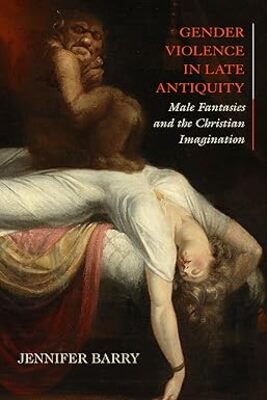
Gender Violence in Late Antiquity confronts the violent ideological frameworks underpinning the early Christian imagination, arguing that gender-based violence is not peripheral but is fundamental to understanding early Christian history. By analyzing hagiographical and doctrinal writings, Jennifer Barry reveals how male authors used portrayals of feminized suffering to shape ideals of sanctity and power, exploiting themes of domestic abuse, martyrdom, and sexualized violence to reinforce their visions of piety. The study first traces the roots of gendered violence within the Greco-Roman and early Christian imagination, and then explores the disturbing role of male fantasies and dreams in hagiographical traditions. Barry draws on womanist scholarship and engages with trauma studies and feminist horror theory in order to challenge traditional readings of Christian texts, offering new perspectives for understanding how narratives of violence continue to shape contemporary interpretations of gender and power.
-
Contentious Unions: Black Baptist Schools and White Baptist Money in the Jim Crow South
Mary Beth Swetnam Mathews
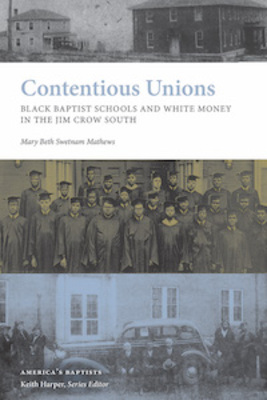
In Contentious Unions: Black Baptist Schools and White Baptist Money in the Jim Crow South, Mary Beth Swetnam Mathews interweaves the stories of the founding and development of Richmond Theological Seminary (Virginia), Central City College (Macon, Georgia), and American Baptist Theological Seminary (Nashville, Tennessee)—colleges that saw challenges, complexities, and hard-won accomplishments in the Post-Reconstruction era. Her study begins just after the Civil War, when one of these institutions provided educational opportunities for newly freed slaves, and follows the fortunes of the schools through the 1960s.
-
Ch. 21: “Both by Sea and Land”: Venetian Trade and Retail in the View
Julia DeLancey
This chapter appears in the book, A View of Venice: Portrait of a Renaissance City. Edited by Kristin Love Huffman.
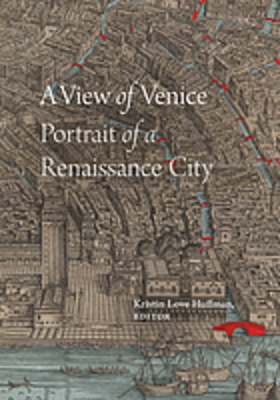
Chapter abstract: Sold at the relatively princely sum of three florins, Jacopo de’ Barbari’s View of Venice proved popular among members of the Serenissima, as attested by the eight versions that still reside in the city. In addition to its cost, the large size would have necessitated space for storage and viewing. It is tempting to imagine the View taking up residence in Venice, perhaps even somewhere in the porteghi, ample quasi-public spheres of the city’s grand palazzi. Much of Venice’s success relied on her prosperous merchant class, some of whom were involved in its pigment trade. With both the means to afford the View and a vested interest in the civic pride it embodies, merchants represent an interesting audience from which to consider the View’s creation.
-
Ancient Women Writers of Greece and Rome
Bartolo Natoli, Angela Pitts, and Judith Hallett
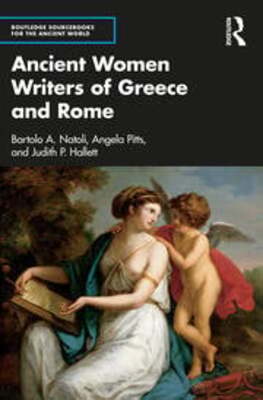
Ancient Women Writers of Greece and Rome features the extant writings of major female authors from the Greco-Roman world, brought together for the first time in a single volume, in both their original languages and translated into English with accompanying commentaries. The most cost-effective and comprehensive way to study the women writers of Greece and Rome, this book provides original texts, accessible text-commentaries, and detailed English translations of the works of ancient female poets and authors such as Sappho and Sulpicia. It takes a student-focused approach, discussing texts alongside new and original English translations and highlighting the rich, diverse scholarship on ancient women writers to specialists and non-specialists alike. The perspectives of women in the ancient world are still relevant and of interest today, as issues of gender and racial (in)equality remain ever-present in modern society.
-
Bishops in Flight: Exile and Displacement in Late Antiquity
Jennifer Barry
Flight during times of persecution has a long and fraught history in early Christianity. In the third century, bishops who fled were considered cowards or, worse yet, heretics. On the face, flight meant denial of Christ and thus betrayal of faith and community. But by the fourth century, the terms of persecution changed as Christianity became the favored cult of the Roman Empire. Prominent Christians who fl ed and survived became founders and influencers of Christianity over time.
-
Doctrine and Race: African American Evangelicals and Fundamentalism Between the Wars
Mary Beth Swetnam Mathews
By presenting African American Protestantism in the context of white Protestant fundamentalism, Doctrine and Race: African American Evangelicals and Fundamentalism between the Wars demonstrates that African American Protestants were acutely aware of the manner in which white Christianity operated and how they could use that knowledge to justify social change. Mary Beth Swetnam Mathews’s study scrutinizes how white fundamentalists wrote blacks out of their definition of fundamentalism and how blacks constructed a definition of Christianity that had, at its core, an intrinsic belief in racial equality. In doing so, this volume challenges the prevailing scholarly argument that fundamentalism was either a doctrinal debate or an antimodernist force. Instead, it was a constantly shifting set of priorities for different groups at different times.
-
Ch. 8: Restoration and Redemption: Defending Kultur and Heimat in Eisenach’s Cityscape
Jason James
The chapter appears in the book, Bloom and Bust: Urban Landscapes in the East since German Reunification. Edited by Gwyneth Cliver and Carrie Smith-Prei.
Chapter abstract: One evening in early 1997, following a dinner filled with discussion of battles over historic preservation and renewal in the small East Ger- man city of Eisenach, Ronald Dieckmann brought out a large illustrated volume with the title The Fates of German Architectural Monuments in World War II: A Documentation of Damage and Total Losses in the Territory of the German Democratic Republic (Eckhardt 1978). 1 The second volume of a series published in the German Democratic Republic (GDR), it covered the administrative districts that were reconstituted after unification as the federal states Saxony and Thuringia. As we paged through scores of “before” and “after” images depicting former grandeur and “senseless” devastation— including Eisenach’s Luther House and old city hall—Dieckmann’s voice became increasingly somber. It was as though we were speaking of deceased family members. After we finished with the book, he went to the window and looked out over the rooftops of the old city toward the autobahn. “Just now we are beginning to repair the damage that Hitler brought upon this country,” he remarked wearily, “and it will take many years to finish it.”
-
Preservation and National Belonging in Eastern Germany: Heritage Fetishism and Redeeming Germanness
Jason James
Preservation and National Belonging in Eastern Germany explores the ways everyday citizens grapple with a difficult national past through heritage. East Germans struggle with an identity doubly burdened by Nazism and socialism, and many seek to manage these burdens by laying claim to a redemptive national past in the form of architectural heritage and the hometown cityscape. Understood as cultural and local rather than political and national, heritage and the hometown appear morally untainted -- not only distinct from but also victimized by forces outside the boundaries of this uncorrupted Germanness. For these East Germans, redemption lies in claiming the role of hometown citizen committed to protecting an endangered cultural identity. Based on extensive ethnographic research, and drawing on cultural anthropology and cultural studies, the analysis sheds new light on the everyday politics heritage and memory by highlighting the dynamics longing, fantasy, fetishism, and local performance.
-
Anthropology and Egalitarianism: Ethnographic Encounters from Monticello to Guinea-Bissau
Eric Gable
Anthropology and Egalitarianism is an artful and accessible introduction to key themes in cultural anthropology. Writing in a deeply personal style and using material from his fieldwork in three dramatically different locales—Indonesia, West Africa, and Monticello, the historic home of Thomas Jefferson—Eric Gable shows why the ethnographic encounter is the core of the discipline's method and the basis of its unique contribution to understanding the human condition. Gable weaves together vignettes from the field and discussion of major works as he explores the development of the idea of culture through the experience of cultural contrast, anthropology's fraught relationship to racism and colonialism, and other enduring themes.
-
Image and Paradigm in Plato’s Sophist
David Ambuel
The Sophist sets out to explain what the sophist does by defining his art. But the sophist has no art. Plato lays out a challenging puzzle in metaphysics, the nature of philosophy, and the imitation of philosophy that is unraveled in this new and unconventional interpretation. Here is a new translation of this important late Platonic dialogue, with a comprehensive commentary that reverses the dominant trends in the scholarship of the last fifty years. The Sophist is shown to be not a dry exposition of doctrine, but a rich exercise in dialectic, which reveals both the Eleatic roots of Platonic metaphysics and Plato’s criticism of unrevised Eleaticism as a theoretical underpinning for sophistry.
The Sophist is presented now not as an artefact of the intellectual past or precursor of late 20th century philosophical theories, but as living philosophy. In a new translation and interpretation, this late dialogue is shown to be a defense of and not a departure from Plato’s metaphysics. The book is intended to provide a complete interpretation of Plato’s Sophist as a whole. Central to the methodology adopted is the assumption that all elements of the dialogue to be understood must be understood in the context of the dialogue as a whole and in its relation to other works in the Platonic corpus. -
Rethinking Zion: How the Print Media Placed Fundamentalism in the South
Mary Beth Swetnam Mathews
Long before the red state/blue state divide, Americans have tended to think of the South as a natural home to and birthplace of Christian fundamentalism. Despite historical evidence and scholarly research to the contrary, the view of the South as a fundamentalist center persists. Rethinking Zion documents the process by which the South received its fundamentalist label and chronicles the forces at work in creating the image of the South as the Bible Belt.
-
Philosophy, Religion, and the Question of Intolerance
Mehdi Aminrazavi and David Ambuel
Philosophy, Religion, and the Question of Intolerance is a diverse collection of essays united by a common starting point and theme-the awareness that intolerance is a phenomenon encountered in diverse places and circumstances and often handled with limited success. The question of toleration, together with its cultural, social, religious, and philosophical implications, is addressed by leading authorities who offer insights from an interdisciplinary perspective.
The book begins with essays by three distinguished scholars, Robert Cummings Neville, J. B. Schneewind, and John McCumber. They assess the origins of intolerance, the genesis of our concept of toleration, and the outlook for the practice of tolerance in contemporary society.
-
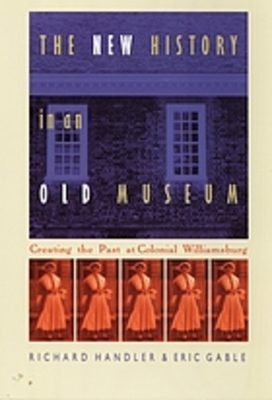
The New History in an Old Museum: Creating the Past at Colonial Williamsburg
Richard Handler and Eric Gable
The New History in an Old Museum is an exploration of "historical truth" as presented at Colonial Williamsburg. More than a detailed history of a museum and tourist attraction, it examines the packaging of American history, and consumerism and the manufacturing of cultural beliefs. Through extensive fieldwork—including numerous site visits, interviews with employees and visitors, and archival research—Richard Handler and Eric Gable illustrate how corporate sensibility blends with pedagogical principle in Colonial Williamsburg to blur the lines between education and entertainment, patriotism and revisionism. During much of its existence, the "living museum" at Williamsburg has been considered a patriotic shrine, celebrating the upscale lifestyles of Virginia’s colonial-era elite. But in recent decades a new generation of social historians has injected a more populist and critical slant to the site’s narrative of nationhood
Printing is not supported at the primary Gallery Thumbnail page. Please first navigate to a specific Image before printing.