

Ch. 9: From the Inner-City to the Cotton Fields: Living and Working Conditions in Martín Espada’s Poetry
Files
Description
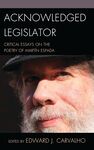
This chapter appear in the book, Acknowledged Legislator: Critical Essays on the Poetry of Martín Espada. Edited by Edward J. Carvalho.
Chapter abstract: On a night in September 2007, packed into the community space at Bus Boys and Poets in Northwest Washington, D.C., my poetry-doubting environmental literature students sat transfixed as poet and activist Martín Espada bellowed lines that blurred the borders between high art and activism. With tears in their eyes, and nodding with new found understanding, they were transported to inner-city tenements in Espada’s poetry, as they vividly pictured living and working conditions far from the comfort of their liberal arts college or their suburban neighborhoods. Poetry, they told me on the trip back to campus, is not just dead words on a page, but rather a relevant means of denouncing injustices to which they would not have otherwise been exposed first hand. Without knowing it, my students were essentially voicing the essence of Lawrence Buell’s definition of environmental literature and the sense of place that literary texts can so powerfully convey.
ISBN
9781611476415
Publication Date
2014
Publisher
Fairleigh Dickinson University Press, in partnership with Bloomsbury
City
Madison (NJ)
Keywords
Environmental literature, Social justice, Latino communities, Poetry
Disciplines
Environmental Health and Protection | Latin American Languages and Societies | Latin American Literature
Recommended Citation
Larochelle, Jeremy, "Ch. 9: From the Inner-City to the Cotton Fields: Living and Working Conditions in Martín Espada’s Poetry" (2014). Modern Languages & Literatures Books. 11.
https://scholar.umw.edu/modernlanguages_books/11